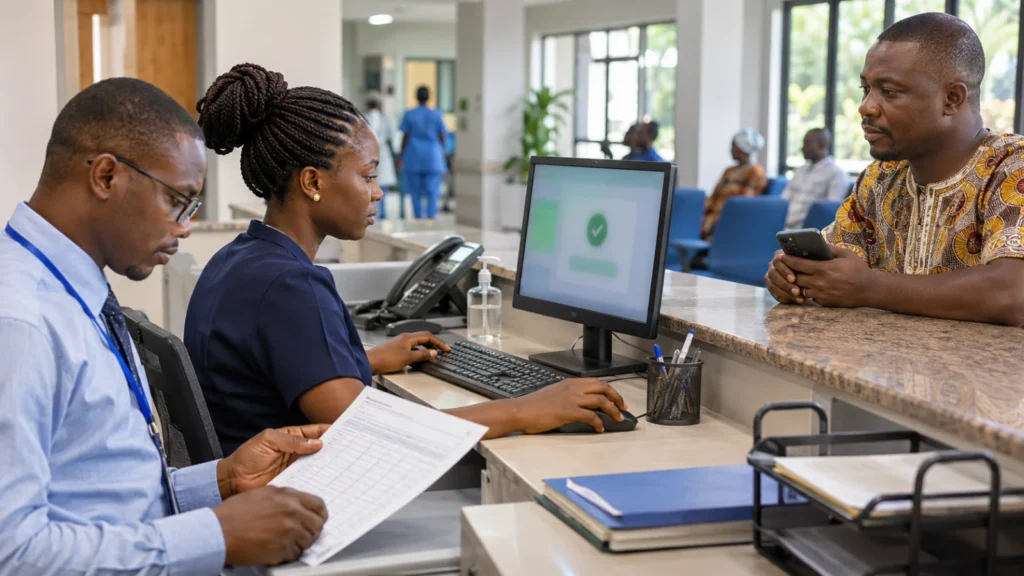
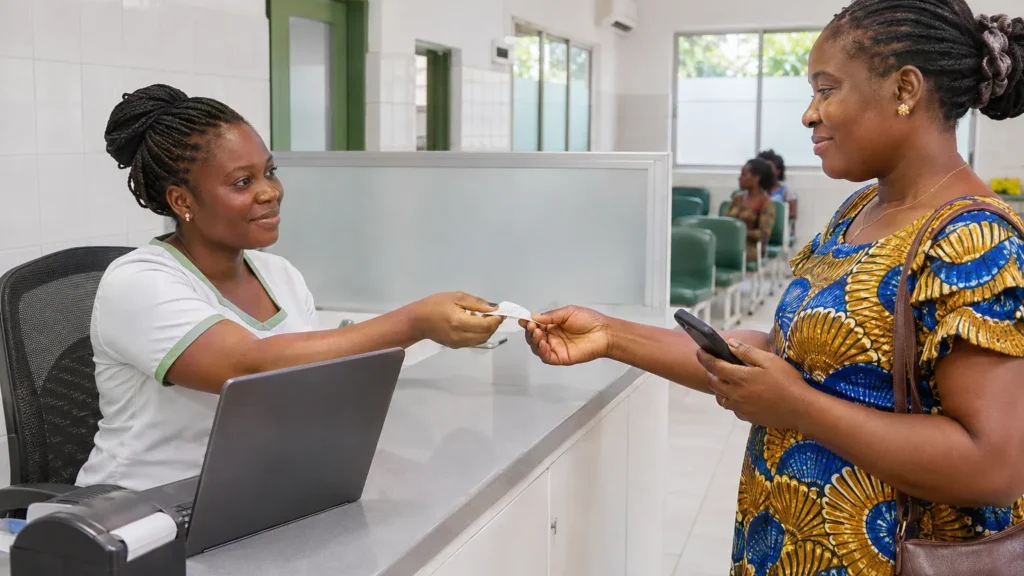
Mobile money helps healthcare facilities collect payments faster, keep less cash on the premises and let relatives pay from a distance. In return, it requires three safeguards: a merchant account in the facility’s name, systematic verification of every payment and a daily reconciliation with the cash office. Well managed, mobile money protects revenue instead of exposing it.
Key takeaways
- Mobile money reduces cash handling and speeds up collection, at the front desk as well as at discharge.
- The main risks are internal: personal numbers, fake confirmation messages and unreconciled transactions.
- A merchant account in the facility’s name and a written verification procedure are the two prerequisites.
- Every payment is recorded with its payment method, then reconciled daily against the provider’s statement.
- Refunds are approved by a manager, never decided by the cashier alone.
Why mobile money is gaining ground in healthcare facilities
Across much of West Africa, the phone already works as an everyday wallet, and in Ghana mobile money is part of daily life. In Nigeria, many patients also pay by bank transfer or card terminal, and the same controls apply. For a hospital or clinic, accepting these payments meets families’ expectations and stops billing from stalling for lack of notes or change.
- Less cash on site: less theft, loss and change errors.
- Faster collection at peak hours.
- Remote payment: a relative can settle a bill from another city.
- An electronic record of each transaction, useful in case of dispute.
- For patients, less cash to carry and proof of payment kept on their phone.
Example: a 25-bed clinic in Tamale admits patients whose families live in Accra. Thanks to the merchant number displayed at the cash desk, a patient’s son pays the admission deposit in cedis from a distance. The cashier checks that the funds have arrived before issuing the receipt.
The risks to understand before you start
The risks rarely come from the technology itself. They mostly come from internal organisation: who receives the money, on which number, and who checks it.
| Risk | Typical situation | Safeguard |
|---|---|---|
| Payment to a personal number | The patient sends money to a staff member’s phone | One official merchant number, any other number banned by internal memo |
| Fake confirmation message | The payer shows an imitation text message | Confirm receipt on the merchant account, never on the payer’s phone |
| Unrecorded transaction | The money arrives but no receipt is issued | Daily reconciliation between statement and recorded payments |
| Wrong amount | The payer mistypes a digit | Written correction procedure, approved by a manager |
| Unexpected fees | Transaction fees reduce net revenue | Know the fee schedule in the merchant contract |
Example: in a health centre in Lagos, a front-desk officer gives out his own number “to save time”. A few weeks later, several payments appear in none of the facility’s statements. A single-number rule would have prevented the dispute.
Setting up mobile money: a 6-step procedure
- Open a merchant account in the facility’s name, never in the name of an employee or the owner.
- Define who views the account and confirms receipt: the cashier checks, the finance manager reviews.
- Display the official number at the cash desk, at reception and on invoices, stating that no other number may be used.
- Write the collection procedure: confirm receipt, record the payment with “mobile money” as the method, keep the transaction reference for reconciliation.
- Plan for special cases: partial payment, wrong amount, refund, network outage.
- Train cashiers and front-desk staff, then check the procedure is followed during the first weeks.
Example: a polyclinic in Kumasi starts with the outpatient cash desk, then extends mobile money to inpatient billing once reconciliations run smoothly. The procedure is adjusted before it applies to the largest amounts.
The daily check: reconciling mobile money with the cash office
Daily reconciliation is the most effective safeguard. It compares the mobile money payments recorded at the cash desk with the transactions on the merchant account statement, for the same day. Any gap is explained the same day or the next morning, while staff still remember what happened.
- The total recorded as mobile money matches the total received on the merchant account, net of fees where applicable.
- Every transaction on the statement matches an issued receipt.
- No “mobile money” receipt exists without a matching transaction.
- The day’s refunds are justified and signed off.
Example: the administrative manager of a clinic in Abuja runs this check every morning for the previous day. A receipt with no matching transaction is cleared up with the cashier before noon. This routine fits into the daily cash controls of a clinic.
Refunds, confidentiality and the regulatory framework
Refunds are the weak point of many procedures. Example: if a laboratory test is cancelled, the finance manager approves the refund against a supporting document, and the money leaves the facility’s account, not the cashier’s phone.
A patient’s phone number and payment history are personal data. In Nigeria, the Nigeria Data Protection Act 2023 governs their processing, overseen by the Nigeria Data Protection Commission; in Ghana, the Data Protection Act, 2012 (Act 843) applies, overseen by the Data Protection Commission. Limit access to statements to those who need it.
Electronic money services are also regulated by central banks: the Bank of Ghana and the Central Bank of Nigeria set the rules for providers in their countries. The merchant contract specifies fees, settlement times and limits: review it with your accountant.
Payments and MediFlow
MediFlow does not replace the provider’s merchant account. Its billing module, in development, aims to record payments, including mobile money, alongside services and insurance.
The mobile money precautions in this article apply right now. To go further, read our article on hospital billing and lost revenue.
Frequently asked questions
Does a clinic need a merchant account to accept mobile money?
Yes, it is strongly recommended. A merchant account in the facility’s name ensures the money lands in an account controlled by management, with statements that can be reviewed. Receiving payments on an employee’s personal number exposes the facility to losses and disputes.
How can we avoid fake payment confirmation messages?
Always confirm receipt on the facility’s side, on the merchant account, never on the payer’s phone. Display this rule at the cash desk so patients know it. The daily reconciliation then catches any gaps that slipped through.
Who should approve a mobile money refund?
A designated manager, usually the finance or administrative manager, and not the cashier alone. The refund must be backed by a supporting document, such as a cancelled service or a wrong amount, and leave a written record. It is paid from the facility’s account.
Want to see how MediFlow fits your facility? Request a free demo.